 "QUANTUM SHOT" #576 Link - article by Simon Rose Don't just wave a black flag... consider your options "There is hopeful symbolism in the fact that flags do not wave in a vacuum" -- Arthur C. Clarke In recent years, we have seen a number of countries disappear, along with their flags. The Soviet Union came to an end, to be replaced by a multitude of new or revived republics, all with their own flags. Czechoslovakia split into its two component parts, while Yugoslavia splintered, as the individual nationalities all asserted their independence. All this happened very recently, but many states have vanished from the map before over the centuries. Here’s a look at some flags of those long gone - and in many cases forgotten - kingdoms and countries.   "Avenue of Flags" - 1933 Chicago World's Fair, images via 1, 2, 3 The Holy Roman Empire, which existed from 962 to 1806, was famously said by Voltaire to be neither holy, Roman nor an empire. It was an attempt to revive the Western Roman Empire, which had collapsed during the 5th and 6th centuries and replaced with by independent Germanic kingdoms. At its peak in the 12th century, the Holy Roman Empire comprised most of the territory of modern-day Germany, Austria, Switzerland, eastern France, Belgium, the Netherlands, western Poland, the Czech Republic and Italy. By the end of the medieval period, the emperor was mostly just a figurehead, with real power based at the local level, with all the emperor’s vassals being virtually independent. This flag was used from 1400 until the empire’s dissolution during the Napoleonic wars in 1806 - 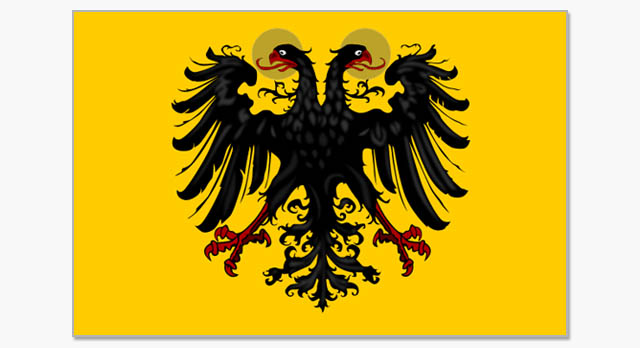 In 1473, Charles the Bold, Duke of Burgundy, was one of the wealthiest and most powerful nobles in Europe, rivaling many royal families. His territory stretched from Switzerland to the North Sea, incorporating large parts of eastern France, Belgium and the Netherlands. He had ambitions to transform his lands into a real kingdom, but his plans to become a monarch ended with his death in battle in 1477, so this flag of the duchy also represents a country that might have been -  A state that lasted for over a millennium was the Most Serene Republic of Venice, one of the superpowers of its time. The republic existed from the late seventh century until 1797, when Napoleon conquered the city.  The Byzantine Empire, or Eastern Roman Empire, was the continuation of the Roman Empire in the medieval period, although over the centuries, it gradually became primarily Greek. The capital was Constantinople, now known as Istanbul. For a thousand years, the Empire was a powerful force, despite military setbacks and territorial losses, but entered into a lengthy decline after the twelfth century, culminating in the Fall of Constantinople to the Ottoman Turks in 1453.The imperial flag featured a double-headed eagle to symbolize the empire’s interests in both Europe and Asia.  Refugees from Constantinople in 1453 helped fuel the Renaissance in Italy, but Byzantine churchmen and nobles also ended up in Moscow, which shared the Orthodox faith of the now defunct empire. Around the same time, the rulers of Russia adopted the title Czar, meaning Caesar or Emperor, and Moscow began to be referred to as ‘the Third Rome’, after Constantinople was the second. The Russian Czars thus saw themselves as the successors to the Byzantine Empire and so adopted the double-headed eagle, using this on their flags until the revolution in 1917:  Imperial Russia wasn’t the only major casualty of the First World War. The Habsburg family was one of the most prominent dynasties in Europe from the fifteenth century onward. Their empire covered almost 250,00 square miles of central Europe, including what are now Austria, Hungary, Slovakia, the Czech Republic, parts of Poland, Romania, Italy, Slovenia, Croatia, Bosnia, Serbia and Montenegro. With a population of around fifty million, the multi national Austrian Empire was one of the great powers of Europe. However, military reverses in the mid-nineteenth century led to a loss of territory and influence in Italy and Germany, and the Habsburgs were forced to come to a new arrangement with the Hungarian half of their empire in 1867. Henceforth the country was known as Austria-Hungary, until its collapse in 1918 -   The kingdom of Prussia was also a great power in Europe in the eighteenth and nineteenth centuries, playing a major role in the war against Napoleon. Prussia was located mainly in the northern portion of Germany, although it also held territory elsewhere, such as in the Rhineland. The eagle was used as the symbol of the country -  In 1870, Germany was unified under Prussian leadership and the German empire was born. This was the Emperor’s standard from 1871 until the end of the empire at the close of the First World War in 1918 - 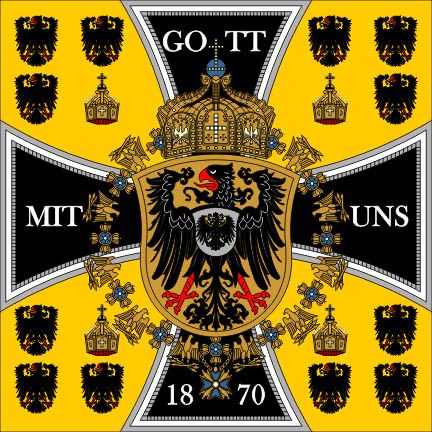  (image credit: Martin Grieve) Napoleon’s flags and coat of arms were seen flying all over Europe in the early years of the nineteenth century -  Napoleon III, ruler of France from 1852 to 1870, clearly used his uncle’s previous flags as an inspiration for those of his own empire -  Although the first Napoleon transformed the map of Italy, for much of the first part of the nineteenth century, Italy was often said to be just a geographic expression and there was no united Italian nation. The peninsular contained a collection of small states and duchies, the largest of which was the Kingdom of the Two Sicilies:  The kingdom comprised the southern part of Italy and the island of Sicily, with its capital in Naples. In 1861, it became part of the United Kingdom of Italy, whose royal flag is shown here -  Yugoslavia disappeared, along with its flag, in recent memory. And yet between the two world wars, Yugoslavia was a monarchy with, you guessed it, a two headed eagle on the flag:  Spain is one of the countries in Europe to still have a monarchy, but from 1931 until 1939 the country was a republic and displayed this flag to symbolize its new direction:  Unfortunately for the republicans, the new direction was short lived and after the Spanish Civil War, this flag was illegal during the Franco Era. Possession could lead to execution or at best an extended prison sentence. After the civil war and until shortly after Franco’s death in 1975, this was the flag of Spain -  Outside of Europe, the Mexican flag has undergone a lot of changes since the early nineteenth century, but this one depicts one of the short lived emblems of the Mexican state, the second Mexican empire, which ran from 1864 to 1867. When President Juarez suspended payments of interest to foreign countries, Spain, France and Britain, Mexico’s main creditors, united by sending a fleet to Mexico to force the government to pay its debts. Britain and Spain soon withdrew, but France, ruled by Napoleon III, remained with a large army and proceeded to conquer the country. With the US still engaged in the Civil War and unable to intervene, Napoleon III helped establish Maximilian of the house of Habsburg, brother of the Austrian Emperor, on the throne of Mexico. The empire faced civil war right from the start and in 1867 Emperor Maximilian was executed by firing squad by the victorious rebels:  Mexico wasn’t the only monarchy in the Americas. The Empire of Brazil, under the rule of Emperors Pedro I and Pedro II, existed from 1822 until 1889. After the occupation of Portugal by Napoleon, the royal family fled to exile in Brazil, their most important colony. After the fall of Napoleon, Brazil became independent of Portugal, but kept a member of the royal family as the head of state -  Also in South America, when the area threw off Spanish rule in the early nineteenth century, one of the early republics was Gran Colombia, which included much of northern South America and a small portion of southern Central America from 1819 to 1831. It later split up into the countries we know today as Colombia, Ecuador and Venezuela -  In Asia, the Qing Dynasty ruled China, Manchuria, Tibet, Taiwan and Mongolia from 1644 to 1912. This flag dates from the period from 1890 to the establishment of the republic in 1912 -  Iran, of course, was also once a monarchy, which flew this flag until the late seventies -  In Africa, Ethiopia is the oldest independent country and also has one of the longest recorded histories in the world, including a long list of monarchs. Here we see the Imperial flag of Haile Selassie, the country’s last emperor -  And finally, also in Africa, a country often in the news today is Zimbabwe. However, after declaring independence from Britain under Ian Smith in 1965 until 1980, the country was known as Rhodesia, which had this flag at that time -  So there you are, flags of forgotten countries. Hopefully for some of you, these images may have helped jog your memory. BONUS: Speaking about cool flags... Turns out that Greater Tokyo Area, Japan, has a flag for every city and ward inside of it - and they are quite unique and stylish:   (images via 1, 2) CONTINUE TO PAGE 2 OF THIS ARTICLE -> Simon Rose is the author of science fiction and fantasy novels for children, including The Alchemist's Portrait, The Sorcerer's Letterbox, The Clone Conspiracy, The Emerald Curse, The Heretic's Tomb and The Doomsday Mask.  Permanent Link...  ...+StumbleUpon  ...+Facebook  |
Flags of Forgotten Countries
Free Funny Bunny Coloring Pages

Free funny bunny coloring pages. What a funny bunny. Let's take this coloring pages and coloring this paper with your favorite color! Don't worry, you can color this coloring pages for free!
[via]
Spectacular Steampunk Art Update, Part 2
| "QUANTUM SHOT" #575 Link - by A. Abrams "Eye Has Not Seen, Nor Ear Has Heard..." Since our last issue of Steampunk Art Update we saw some truly mind-boggling examples of this sub-genre, with more creative "steam" and inventive "spunk" than can be found anywhere in modern art scene: many of these examples we featured now and then in our Biscotti issues... but now's the time to spotlight two artists that particularly stand out, and mention other upcoming talent.  "Requiem for Industry", art by Almacan: Kazuhiko Nakamura - see more of his "Mechanical Mirage" works Let's start with art by Sam Van Olffen (see his site) from Montpellier (South of France) - he describes himself as a Graphic Sampler. His preferred graphic composition is the result of various pictorial elements removed from their original context, which are then combined with one another to create something.... different. Sam's influences include literature, palmiped and... cathedrals. Here is an epic image "Le Cirque Rouillé" (Circus of Rust) - click to enlarge:  (images courtesy: Sam Van Olffen) Sam Van Olffen photographs real-life objects, and combines them to create a new, darker, fantasy reality, as a DJ might create a new sound:    Our favorite is the "Post-Nuclear (Bio-Tox) Romance" series: a date in a cafe... and a gas mask wedding:  Very evocative architectural visions:  During the Hampton's Antique Galleries steampunk exhibition last summer Sam Van Olffen works provided a gorgeous backdrop to the lighting designs of another outstanding artist - Art Donovan.  Steampunk tripod light, and the "Shiva Mandala" (Illuminated Astrolabe) - more info Art Donovan makes lamps that light up the space not just with electricity, but with singular brilliance of their design:  "Siddhartha Pod" lamp - more details Victorian Concept Mayhem, and Other Mechanized Atrocities, by Keith Thompson We featured some sizzling concept art by Keith Thompson before, but his imagination keeps pumping out more and more bizarre vehicles, robots, various un-dead and other un-savory monsters (check his site for more)... some are quite dark, so viewer discretion advised. "Originally a byproduct of alchemical study, the Mollusc Tree is now harvested for both medicinal and culinary applications"... On the right, are the "Halfling Executors of Megalys" (cover art for the Arcane Codex Megalys book by Nackter Stahl Publishing).  A scrivener automaton - "The Scribe" - working in a rather wealthy merchant's library:  World War Two design sensibilities play a major part in Keith's military vehicle concepts:   Iron Grip: the "War Zeppelin" and ST-38 tank  "Jonah's Fortress", click to enlarge The "Romulus" is a wicked-looking robot concept, with or without its armor -  Click to enlarge, also check out very neat spaceship concept Finally, a gorgeous, baroque-styled "Dajjal" robot:  (images credit: Keith Thompson) Pre-order "Leviathan" (a rather grandiose illustrated steampunk book) by Scott Westerfeld, illustrated by Keith Thompson - soon to be published by Simon and Schuster - click here Steampunk Walking Cities... what more could you possibly want? Daniel Dociu dreams big. Simply steampunk vehicles and mad scientists are too small in scale, why not paint the mobile cities - sort of glorified "Howl's Moving Castles"? Check out how radical this looks, and you'll agree that sometimes the bigger is truly the better:    Reminds us of the scenes from China Mievelle's "Perdido Street Station"... same crazed apocalyptic mega-city approach. See more of this artist work here. Finally, this image we've already shown once in our Biscotti issue, but it has the quint-essential steampunk quality: enjoy, and visit Alex Broeckel's awesome gallery: "Steam Octopus" (click to enlarge):  (art by Alex Broeckel) READ THE FIRST PART HERE! -> Also see our whole "Steampunk" category! -> Permanent Link......+StumbleUpon ...+Facebook |
Link Latte 114

#114 - Week of July 1, 2009
Futuristic Movie Timeline, larger - [cool chart]
Ant mega-colony takes over world - [wow nature]
Videos about the symbols of physics and astronomy - [science]
Diving Gunung Api: Volcano of the Sea Snakes - [wow travel]
Russian scientists vs. dog's severed head - [weird]
Visual Economics: great infographics, example - [charts]
Life and death in the storm drains of Las Vegas - [flickr set]
Ways to get on top of a rainforest canopy - [cool article]
incredible imagery of the Salton Sea - [abandoned]
Interesting modern spacesuit design - [space tech]
Electrifying "High Voltage" Photography - [art]
Unknown life forms in Carolina sewers... fake? - [gross video]
Miracle rescue robots from Japan - [wow tech]
Cool round-up of concept bikes - [design]
Ecological disasters shown in a zoo in Vienna - [interesting] - via
Fantastic Fashions and Strange Styles - [compilation]
Neat creative job opportunity in London... - [cool project]
...or you can just drink around the world, in 80 pubs - [cool site]
"Competitive advertising" and vintage creepy ads - [funny]
12 Things You THOUGHT Were Bad for You... - [weird]
No lifeguard on duty... sad abandoned pools - [neat photos]
Everything you wanted to know about dogs in bags!! - [fashion]
Russian cruise company offers pirate hunting trips - [weird]
The Idiot Box: Drama of TV heads - [cool video]
Ducks going up the escalator - [fun video]
Winston Churchill's declaration, put to a space tune - [fun video]
Crazy (dancing) Romanian truck driver - [fun video]
The "Web Site Story" Musical - [epic short film]
Blu Electronic Cigarettes - [cool idea, promotion]
Make stunning Flash websites for free! - [promotion]
The "Most" Humans: interesting facts - [can be gross]
SEE ALL OTHER LINK LATTE ISSUES HERE
Subscribe to:
Posts (Atom)


