 "QUANTUM SHOT" #611 Link - article by M. Christian and A. Abrams Almost as good as "The Festival of the Freshwater Squid" (see here) As one travels the globe and observes the variety of fairs, festivals, and frivolities, it becomes clear that: 1) the concepts of "weird, strange, bizarre" are really in the eyes of the beholder - and 2) that all humans, no matter where we live, are more than just a bit bonkers.   (image via) Making a big deal out of "throwing things" Although human behavior doesn't vary much, the methods of public celebrations certainly do. For some baffling reason, for instance, people like to throw things. And depending on the country, what they throw is likely to be different. In Binche, a small town in Belgium, the projectile of choice is a fruit. On Sunday, Monday, and Tuesday before Ash Wednesday Binche the town is visited by masked figures called Gilles who – later on in the festivities – carry large baskets of oranges through the town. Many of these oranges are calmly, orderly, handed to residents as well as tourists. Others, though, are rather vigorously … well, thrown at wary residents and unfortunate tourists.  (images via) Another "Battle of the Oranges", in Ivrea, Italy:  (image via) Meanwhile, if you happen to be in Buñol, Spain, on the last Wednesday in August, you also might want to duck as the fruit thrown there – while not as hard or potentially damaging as an orange – can still sting a bit. What's fun about La Tomatina at Buñol isn't just the hurled tomatoes but that the town, which normally has a population around 10,000, swells to closer to 60,000 as folks from all over come to throw -- and get thrown at.    (images credit: Fernando Bustamante, via 1, 2) If you happen to be in Taihape, New Zealand, things will be flying through the air but none of them – at least as far as we know – have been thrown at anyone. Nevertheless, a festival where people try to throw a gumboot as far as possible could pose some risks to passersby and participants alike.  (a giant gumboot near Taihape, photo by Aaron Hape) A landscape nearby is seemingly made to be explored in these gumboots (provided you can catch some free ones):  (image credit: Cristiano Corsini) "Oni wa soto! Fuku wa uchi!" are words you might want to keep an ear open for if you're in Japan during Setsubun, and happen to see a member of your household holding a handful of roasted soybeans. Mamemaki is the term for it, and "Oni wa soto! Fuku wa uchi!" ("Demons out! Luck in!") is what is traditionally said before the beans are thrown out the front door – or at another member of the family (maybe even at the house cat):  (images via 1, 2) If you happen to be in India during Holi, the festival of color, you also might want to avoid wearing your best suit of clothes. As part of the celebration, a brightly dyed powder called abir is merrily thrown everywhere – and especially at each other.   (images via, REUTERS/K. K. Arora)  (image credit: Ankita Asthana)  (image credit: Brad Beaman) Other Splendid Festivities Fortunately, not all festivals in the world include hurled objects. Some just have unique themes. Japan's Hōnen Matsuri is a fertility festival, uniquely celebrated in the city of Komaki. By unique we mean prodigious, tumescent, large, and … okay, enough with the jokes, especially since the object of the fertility being celebrated is that certain part of the male anatomy. A similar festival is also held in Kawasaki, called Kanamara Matsuri. See images here - warning, nsfw. While nothing is thrown, and nothing terribly phallic is evident, there's a festival that absolutely has to be mentioned: an event featuring tremendous beauty that ends with ashes and smoke. Around the middle of March, the city of Valencia, Spain, has a festival called Falles – a celebration of Saint Joseph. But long before the Falles, Valencia, the third largest city in Spain, begins to prepare: neighborhoods and a wide variety of organizations form groups called Casal Fallers who raise money for their own contributions to the festivities. It's these contributions that make the event so incredible. Each group – working from a common theme selected for that year – creates a ninot, or puppet. Fashioned from paper, wax, Styrofoam, and a few other materials, ninots are whimsical, outrageous, profane, comical, political, and every one is incredibly beautiful.  (images via) The artisans of Valencia have had a very long time to perfect their craft, and it shows in each and every ninot (see a whole bunch here). Each figure and tableau is a hallucinatory mixture of a Renaissance masterpiece and a three-dimensional cartoon. Each one, too, is frequently a wildly executed satirical jab at everything from politics to tradition, from pop culture to the Falles celebrants themselves. Nothing is sacred, nothing is spared.   (images via) Then come the fires, and then the ashes. Yes, you guessed correctly: each and every minot, every figure and tableau is lit – exploding into the night sky in a roaring conclusion called La Cremà. In the morning there is nothing but ashes, and the memory of the wonders of the falles. Boryeong Mud Festival, South Korea:    (images via) The Pig Parade of Malolos, Phillipines:  (images by Erik de Castro/REUTERS, via) One of the weirdest festivals of all time - El Colacho in Spain. On this occasion grown men are jumping over the new born babies. Yes, very carefully (mothers do not seem to protest). They do it to get rid of any unknown evil spirits that might hide in these babies:  (photo by Dennis Doyle, AP) Cheese Rolling, Cooper's Hill, Gloucestershire, England:  (images via) Chocolate Festival in Kiev, Ukraine (with a huge chocolate fountain on the left):  (photos by Yuliya Ilyinskaya) Prayer for rain during Varuna Yajna ritual, at Sankara Mattham, India:  (photo by Indranil Mukherjee/AFP/Getty Images) Lorraine Mondial Air Balloons Festival in Chambley, France:  (image via) Gothic and Steampunk Festival in Leipzig, Germany (Wave-Gotik-Treffen, WGT):  (images via 1, ) A neat little dance at the Kasedori Festival (a fire-prevention festival) at Kaminoyama, Japan: Link CONTINUE TO "THE RADICAL MANNEQUINS SHOW" ->  Permanent Link...  ...+StumbleUpon  ...+Facebook  |
Weird Festivals & Strange Celebrations
Funny Money: Unusual and Fascinating Currency
| "QUANTUM SHOT" #48 Link - article by Simon Rose and Avi Abrams Graphical Marvels, Forged Notes, Hyperinflation "Riches" and Propaganda Bed Sheets "Paper money eventually returns to its intrinsic value - zero." (Voltaire, 1694-1778) World's historical bank notes often provide the clearest and unique view on country's political and design sensibilities. For example, old Russian Empire bank notes were pretty elaborate and some of the largest in size:  (1912 Russian empire banknote with Czar Peter the Great) German crisis money around 1921 "Serienscheine" (series notes) are especially fascinating from a graphical viewpoint - see more here:    (images via) Imaginary (thank God!) Bank of Cthulhu:  (image via) Polish bank notes with Frédéric Chopin - an epitomy of culture:  (image via) A humble squirrel is featured on bank notes from Belarus:  The world’s oldest known banknote The earliest recorded use of paper money is in China around 800 AD, although the Chinese abandoned paper money in the mid fifteenth century. This Chinese Kuan note is the world’s oldest known banknote, from around 1380.  (left: the Kuan note; right: painting from this period, by Ni Zan - images via 1, 2) European paper money as we would recognize it today seems to have its origins in the seventeenth century. In 1633, English goldsmith certificates were being used as receipts for customers to reclaim deposits, and also as evidence of someone’s ability to pay. By 1660, these receipts were recognized as a convenient alternative to handling coins or bullion, a forerunner perhaps of the banknote in England. The Bank of Sweden was founded in 1656, granting loans and mortgages, issuing bills of credit and taking deposits. In 1661, it was the first chartered bank in Europe to issues notes. This hundred Daler note was issued in 1666:  (image via) In the UK, the Bank of England has been issuing banknotes since 1694, but didn’t have a legal monopoly until 1921. Decimal currency was introduced in the UK on February 15, 1971. The fifty pence coin, one of the first new ones issued, is very familiar to the people of Britain since its introduction almost four decades ago, but still seems odd to the outsider with its heptagonal shape (below, left).  (images via 1, 2) The British public, however, had seen a multi-sided coin before. The threepenny bit was introduced in the mid-thirties, although a threepenny coin had been minted in silver since 1547. The twelve-sided version would remain in circulation until 1970 (above, middle). However, the new decimal system wasn’t without its oddities. The half penny coin enjoyed a surprisingly long and increasingly pointless existence, before it was withdrawn from the monetary system in 1984 (above, right). Scotland has a number of distinct institutions, quite separate to England and Wales, and this includes currency. Scottish banknotes are recognized as currency in Scotland and usually in other parts of the UK, but may be refused by people in stores who are unfamiliar with such notes. However, they are of the same value as English notes and financial institutions will accept them without question:  Banknotes issued by Northern Ireland banks have similar status to Scottish ones and can technically be used anywhere in the UK. However, they are rarely seen outside Northern Ireland and are thus equally rarely accepted in England and Wales, although once again, financial institutions will readily take them. This limited edition banknote from 2006 commemorates the soccer legend George Best:  o The Channel Islands and the Isle of Man are somewhat confusingly possessions of the British Crown, but not part of the UK. Consequently, although they have currency unions with London, they each issue their own banknotes. However, unlike Scotland and Northern Ireland, these notes cannot be used in the UK. This Isle of Man banknote displays the island’s famous three-legged symbol:  These examples are from the islands of Jersey and Guernsey, located off the northern coast of France:   (images via) The Channel Islands were the only British territory to be occupied by Germany during World War Two. These are pictures of currency used during the German Occupation. The top ones were used by the people of Guernsey, while the lower one shows the military currency used by German army:  Also from World War Two, here is this great example of forged currency. Operation Bernhard was the German plan to destabilize the British economy by printing phoney banknotes in various denominations. In 1943, 500,000 notes were produced, which were planned to be parachuted over Britain. The Allies retrieved most the notes at the end of the war, but forgeries still occasionally appeared for several years after 1945:  Remnants of a once mighty empire, there are fourteen British Overseas Territories which all issue their own currencies, including Gibraltar, Saint Helena and the Falkland Islands, none of which are legal in the UK or outside the territories of origin (below, left):  (images via) In 1936, King Edward VIII abdicated the throne of England and was never actually crowned. As a result, coins bearing his head are collectors items. In the 1930’s, the British Empire spanned the globe and here’s a sovereign minted for the new king in Canada (above, right) Also from North America, no article on currency would be complete without some mention of banknotes issues by the Confederate States of America during the Civil War. Here are two examples of Confederate twenty dollar bills from 1861 and 1864:   (images via) There was of course another independent country in the southern part of what is now the United States a few decades earlier. Here’s some money issued by the Republic of Texas in the 1830’s:  (image via) Although the shape of the British three penny and fifty pence coins may seem somewhat odd to non-UK residents, how about these coins minted in Zambia in honour of the 2000 Sydney Olympics? -  (image via) Also in Africa, the economic troubles of Zimbabwe in recent years have been reflected in the currency, such as this ten million dollar banknote from 2008:  However, it has been exceed by far with this one (click to enlarge):  (image via) Zimbabwe is not the first country to experience such hyperinflation, of course. After the First World War, Germany endured a severe economic crisis. In 1914, the highest denomination German note was for 1000 Mark, which was worth approximately 238 US dollars or 50 British pounds. In early 1922, the government issued 10,000 Mark notes, but by February 1923, Germans were using banknotes in denominations of 100,000 and 1 million Marks. Notes reached 50 million in July, 10 billion in September and 100 trillion when hyperinflation peaked in October 1923. Just to give you an idea of what this meant for the average German, on November 1 1923, you could buy a loaf of bread for a measly three billion or truly splash out and get three pounds of meat for 100 billion. By November 15, 100 billion would get you two glasses of beer, not really enough to make you forget your troubles, while that loaf would now cost you 80 billion. When it was all over, these huge banknotes were worth around 5 pounds or 24 US dollars. On November 15, the government introduced a new currency, one unit of which was worth a trillion of the old Marks. Prices eventually stabilized, but most of the population had nevertheless seen their wealth vanish. 5 Million Mark Note issued in Dresden on August 21, 1923:  Ten million:  50 million:  100 million:  500 million:  100 trillion, Nov. 3 1923 - see this site for more:  (image via 1, 2, 3, 4) Later in the interwar period Germany got a new government who’s head actually resisted having his own head on the national currency. However, with victory seemingly within sight, Adolf Hitler decided that his head should indeed adorn the country’s money, after the anticipated final triumph. This design for a five reichsmark coin was struck in 1942, but never issued:  The following banknotes were created by the Nazis for the infamous concentration camp, at Theresienstadt in what is now the Czech republic. The camp served as a showpiece for the Nazis to demonstrate to the Red Cross and other agencies how Jewish prisoners were being well treated, took part in cultural events and had schools for their children. In reality, over 30,000 people died in Theresienstadt and almost 90,000 were sent from there to extermination camps further east. These 10 and 20 Kronen notes were part of the propaganda ploy presented to the Red Cross, but were simply papers with no value and never used:  Hitler’s fellow dictator, Josef Stalin, got his head on the 100 Kronen coin in Soviet occupied Czechoslovakia 1949:  In Asia, World War Two resulted in what turned out to be temporary occupation currency in a number of different countries. This ten military yen note 1941 was issued during the Japanese occupation of Hong Kong: 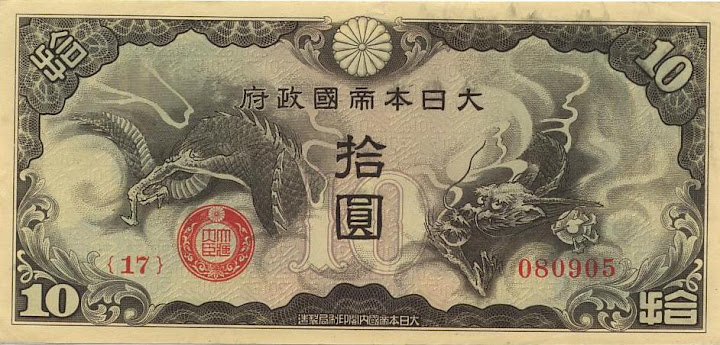  (image via) This one is from the Philippines occupation:  This 1944 100 Yuan banknote circulated in the Japanese puppet state of Manchukuo, better known as Manchuria, in north west China:  And finally, also from Asia, probably the largest banknote in the world - 16cm(6.3in) by 16cm(6.3in) - issued in Thailand in 1987:  Bank note origami from a Japanese artist Hasegawa Yosuke - see his site for more:  (image credit: Hasegawa Yosuke) For richer, or for poorer... collecting money is what most people do, or strive to do, anyway: 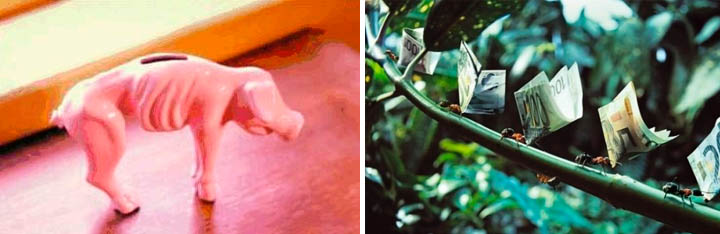 CONTINUE TO "WORLD'S MOST CURIOUS EPHEMERA" -> Simon Rose is the author of science fiction and fantasy novels for children, including The Alchemist's Portrait, The Sorcerer's Letterbox, The Clone Conspiracy, The Emerald Curse, The Heretic's Tomb and The Doomsday Mask. Permanent Link......+StumbleUpon ...+Facebook |
Link Latte 126

#126 - Week of January 28, 2010
Very Tight Pass on a Mountain Road - [awesome video]
China's Instant Cities - [great article]
Boeing 777 in X-Ray Photography, pic - [fascinating]
Super-detailed Weather & Nature Models - [using everyday objects]
Temples of Knowledge: Spectacular Historical Libraries - [gallery]
This artist makes "fake" photographs of the WWI ships, example - [gallery]
P-Eco Concept Car Vibrates to Move - [cool tech]
Gorgeous Manuscript: The Hours of Catherine of Cleves, scans - [vintage]
The Deepest Hole Ever Drilled, more - [interesting]
Breathtaking Avatar-like Rock Formations, original - [wow nature]
The Round Fireplace - [neat interior design]
Neat Nintendo DS Case Mods - [geek art]
Internet Vices: Social Sites as... Drinks - [funny, some language]
Visualizing Greatest Design Quotes - [scroll down]
Mesmerizing and Beautiful 3D Architectural Film - [all-CG animation]
How the above movie was done... by one man - [cool video]
The Most Expensive Camera in the World - [put on auction]
Movie Made By Chimpanzees To Air On The BBC - [weird]
Romanian guy cleans the snow off his car... - [still cleaning...]
The First Piece of Electronic Music: 1955, info - [weird]
Long-forgotten Breakfast Cereal Boxes - [unique collection]
Strange & Sensational Scientific Discoveries - [cool info]
Really Hungry Cat - [wow video]
"Gimme Dat Thing" - this is going to stick to you for days - [neat dance video]
Hitler is upset about new iPad - [fun video, some language]
Mongol Soldiers Sing a Sweet Love Song - [sitting in the snow]
"The Great Race" Spectacular Pie Fight - [fun video]
One of the Best Car Chases: "Freebie & The Bean" 1974 - [wow video]
Best Online Flash Games - [promotion]
Compilation of Insect Macro-Photography - [nature]
SEE ALL OTHER LINK LATTE ISSUES HERE
Subscribe to:
Posts (Atom)


